
Leg Positioning and Machine Stability for Spider Excavators on Uneven Ground
Spider excavators reach work that most excavation equipment cannot. They set up on steep embankments, rocky hillsides, stream banks, terraced gardens, and broken ground where a conventional tracked excavator would struggle to find a level, stable platform. That capability comes from one defining feature: independently adjustable support legs that let the machine conform to the terrain beneath it.
Those legs carry the full weight of the machine. They also carry every force the boom, arm, and bucket create during digging, lifting, and swinging. When each leg rests on solid ground within its permitted range, the excavator works from a stable, predictable base. When one leg sits on loose fill, a hidden void, saturated soil, or an unsupported edge, the whole machine's stability depends on ground that may not hold.
Leg positioning is therefore much more than a setup step. It is the foundation of safe operation on uneven ground. Stability depends on how well the ground is assessed, where each support point is placed, how far each leg is extended, how the boom moves during work, how close excavation comes to the legs, and how carefully conditions are monitored as the job progresses. A mistake in any one of these areas can lead to sinking, sliding, or tipping, with serious consequences for the operator and the crew.
Assessing the Ground
Every stable setup begins with an honest assessment of the ground. A spider excavator spreads its weight across a small number of support points, and each point concentrates a significant load into a small area of soil or rock. Ground that supports a person walking across it, or even a light vehicle, may not support that concentrated load once the boom begins to dig.
Walk the entire work area before bringing the machine in. Inspect the specific locations where legs are likely to rest, as well as the ground between and around them. Look for the following conditions:
Loose soil: Recently disturbed, eroded, or sandy soil can compress or shift under a leg, particularly once digging forces are applied.
Soft spots: Organic soil, decomposed vegetation, and areas that yield underfoot may lack bearing capacity.
Rocks: Solid bedrock can provide excellent support, but loose rocks, boulders resting on soil, and fractured outcrops can roll or split under load.
Voids: Old root systems, animal burrows, abandoned drainage pipes, buried tanks, collapsed culverts, and previous excavations can leave hollow areas beneath a surface that looks solid.
Waterlogged ground: Saturated soil loses strength and can behave unpredictably under concentrated loads. Springs, seepage, and drainage paths can soften ground that appears dry on the surface.
Unsupported edges: Embankment crests, retaining walls, trench edges, eroded banks, and terrace drops can break away when a leg is placed too close.
Fill material: Recently placed or poorly compacted fill may settle unevenly, and its depth and condition are often unknown.
A surface that appears firm may not support concentrated loads beneath a leg. A thin crust of dry soil can sit above saturated material. Turf can hide loose fill. A layer of gravel can bridge over a void until the weight of the machine collapses it. Where there is any doubt, probe the ground with a steel rod or a suitable hand tool, dig a small test hole to check the soil profile, or consult the site's geotechnical information where it exists.
Consider the ground's history as well. Ask the property owner or site supervisor about previous construction, demolition, utility work, drainage installations, septic systems, or filled areas. Look at the surroundings for clues, such as uneven settlement, standing water, cracked paving, and changes in vegetation.
Check the weather and the season. Rain, snowmelt, and freeze-thaw cycles change ground strength quickly. Ground that is suitable on a dry morning may become unsuitable after a heavy afternoon storm.
Follow site requirements for ground assessment and preparation. Some projects call for engineered working platforms, compacted pads, or specific inspection procedures before equipment is placed on a slope. When the assessment raises concerns that cannot be resolved, prepare the ground, select a different setup location, or choose a different method rather than relying on the machine's adaptability.
Key takeaway: Inspect the work area for loose soil, soft spots, rocks, voids, waterlogged ground, and unsupported edges before setup, probe suspect areas, and never assume that a firm-looking surface can carry the concentrated load beneath a leg.
Choosing Support Points
Once the ground has been assessed, select the exact locations where each leg will rest. These support points determine how the machine's weight and working forces transfer into the ground. Careful selection gives the excavator a stable base. Poor selection creates weak points that may fail without warning.
Position support legs on ground capable of carrying the machine's loads. Each leg carries a share of the machine's weight while it is idle, and that share changes continuously as the boom swings, extends, lifts, and digs. A support point must handle the highest load it is likely to see during the planned work, not just the load when the machine is stationary.
Good support points share several characteristics:
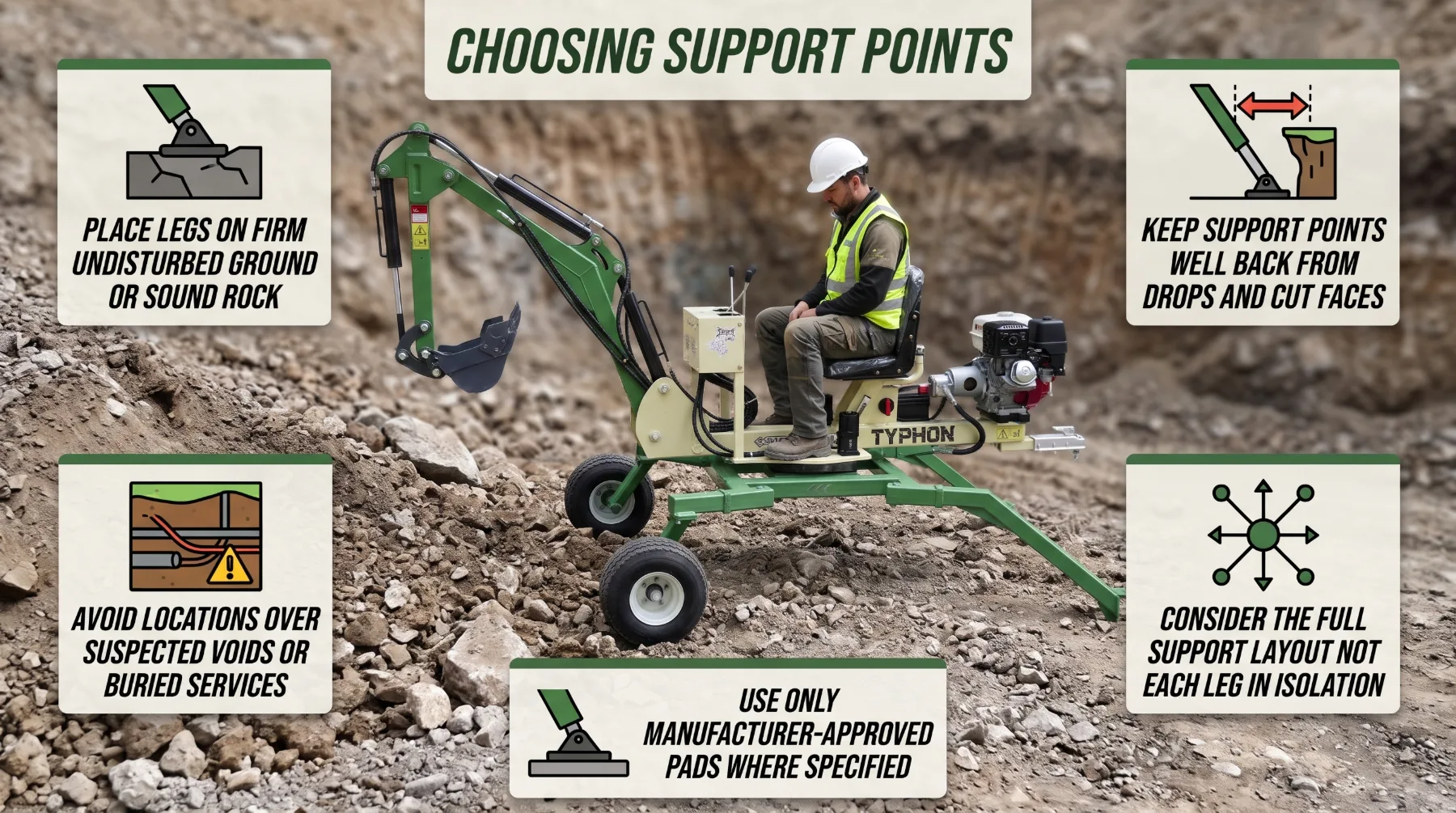
Firm, undisturbed ground: Native soil that has not been recently excavated, filled, or eroded generally provides more consistent bearing.
Solid rock: Sound bedrock offers strong support, provided it is not fractured, sloping steeply under the leg, or covered by loose debris.
Stable footing for the pad or foot: The leg's foot or pad should seat fully on the surface rather than balancing on a ridge, edge, or single point.
Adequate distance from edges: Support points should sit well back from drop-offs, excavation faces, retaining walls, and eroded banks.
Freedom from hidden hazards: Avoid locations over suspected voids, buried utilities, drainage structures, and areas identified as questionable during assessment.
Support pads and other load-spreading equipment can help in some situations. Approved pads increase the contact area beneath a leg, reducing ground pressure and the tendency to sink. Use approved support pads or other equipment only as specified by the manufacturer. Improvised blocking, stacked timber, loose stones, or unapproved plates can slide, crush, or tip under load, creating a less stable condition than the bare ground.
Pads have limits. They spread load across a larger area, but they do not make unstable ground safe by themselves. A pad placed over a void, on the edge of an embankment, or on saturated fill can still fail. Treat pads as a supplement to good support point selection, never as a substitute for it.
Think about the whole support layout, not each leg in isolation. A well-chosen setup positions the legs to provide a balanced base that suits the direction and range of the planned work. Where the boom will spend most of its time working toward one side, the support points on that side carry more load and deserve the most careful selection.
Key takeaway: Place each leg on firm, undisturbed ground or sound rock that can carry the machine's highest working loads, avoid loose fill, unstable rocks, and edges, and use only manufacturer-approved support pads, remembering that pads do not make unstable ground safe.
Adjusting Leg Position
With support points selected, the legs must be set to place the machine in a stable working position. Spider excavators allow the operator to adjust each leg independently, extending, retracting, and angling them to match the terrain and level the upper structure. That flexibility is the machine's greatest strength on uneven ground, and it must be used within clearly defined limits.
Set the legs according to the machine's operating instructions and the terrain. The manufacturer's procedure defines the sequence for deploying the legs, the order in which they should be loaded, and the method for leveling the machine. Follow it exactly. Controls and leg systems differ between models, and a procedure that works on one spider excavator may not apply to another.
Confirm that the excavator is within its permitted leveling and support range before digging. Every spider excavator has limits on how far each leg can extend, how much the upper structure can be leveled, and the slope on which the machine may operate. These limits are defined in the operator's manual and often indicated by onboard displays or warning systems. Working outside them reduces stability and increases the risk of tipping.
Do not extend a leg beyond its limits to reach an unstable support point. When the ideal support location is out of reach, the temptation is to stretch a leg as far as it will go or to accept a poorer support point nearby. Both choices weaken the setup. A leg at full extension may have reduced strength and leaves no adjustment margin if the ground settles. A leg on a poor support point may sink as soon as digging begins.
When the machine cannot be set up within its permitted range, stop and reconsider. Options include preparing a working platform where the project allows, approaching from a different direction, breaking the work into stages from several stable positions, or selecting different equipment.
Engage any locking or holding features the manufacturer provides once the legs are set. Confirm that warning lights, tilt alarms, and stability indicators show the machine is within its limits before beginning work.
Key takeaway: Set the legs using the manufacturer's procedure, load them gradually, confirm the machine is within its permitted leveling and support range before digging, and never extend a leg beyond its limits to reach a poor support point.
Boom Movement and Stability
A stable setup is only the starting point. Once the machine begins to work, the boom, arm, bucket, and upper structure constantly shift the forces acting on each leg. Understanding how these movements affect stability helps operators keep the machine within safe limits throughout every cycle.
On a slope, these effects grow stronger. The downhill legs already carry a larger share of the machine's weight. Extending the boom downhill, swinging a load toward the downhill side, or lifting at reach in that direction adds even more. A movement that is acceptable when working uphill or across the slope may exceed safe limits toward the downhill side.
Avoid reaching farther or lifting heavier loads than the machine's configuration permits. Lifting capacity drops as reach increases, and the charted capacity assumes the machine is properly supported within its permitted range. Combining long reach with heavy loads, poor support, or a slope removes the margins that protect the machine from tipping.
Watch for warning signs during work. A leg lifting off the ground, a sudden change in machine angle, tilt alarms, unusual creaking, or movement at a support point all indicate that loads are approaching the machine's limits. Stop immediately, bring the bucket in close and lower it to the ground in a controlled manner, and reassess before continuing.
Always wear the seat belt and keep the operator restraint system in place. These systems keep the operator within the protective structure if the machine tips or moves suddenly.
Key takeaway: Boom extension, swinging, lifting, and digging forces continuously shift load across the legs, so use smooth control inputs, keep loads close, limit downhill reach, and stay within the manufacturer's load charts and operating envelope.
Rechecking During Work
A stable setup at the start of a shift does not guarantee stability for the rest of it. Ground conditions change as excavation progresses, as loads are applied repeatedly, and as weather affects the site. Continuous monitoring is what keeps a good setup safe through every hour of work.
Weather deserves particular attention. If rain begins, monitor support points more often, and stop work if water starts pooling around the legs or flowing toward the excavation. After a break in work, especially an overnight stop, reassess the full setup before resuming, since ground conditions may have changed while the machine was idle.
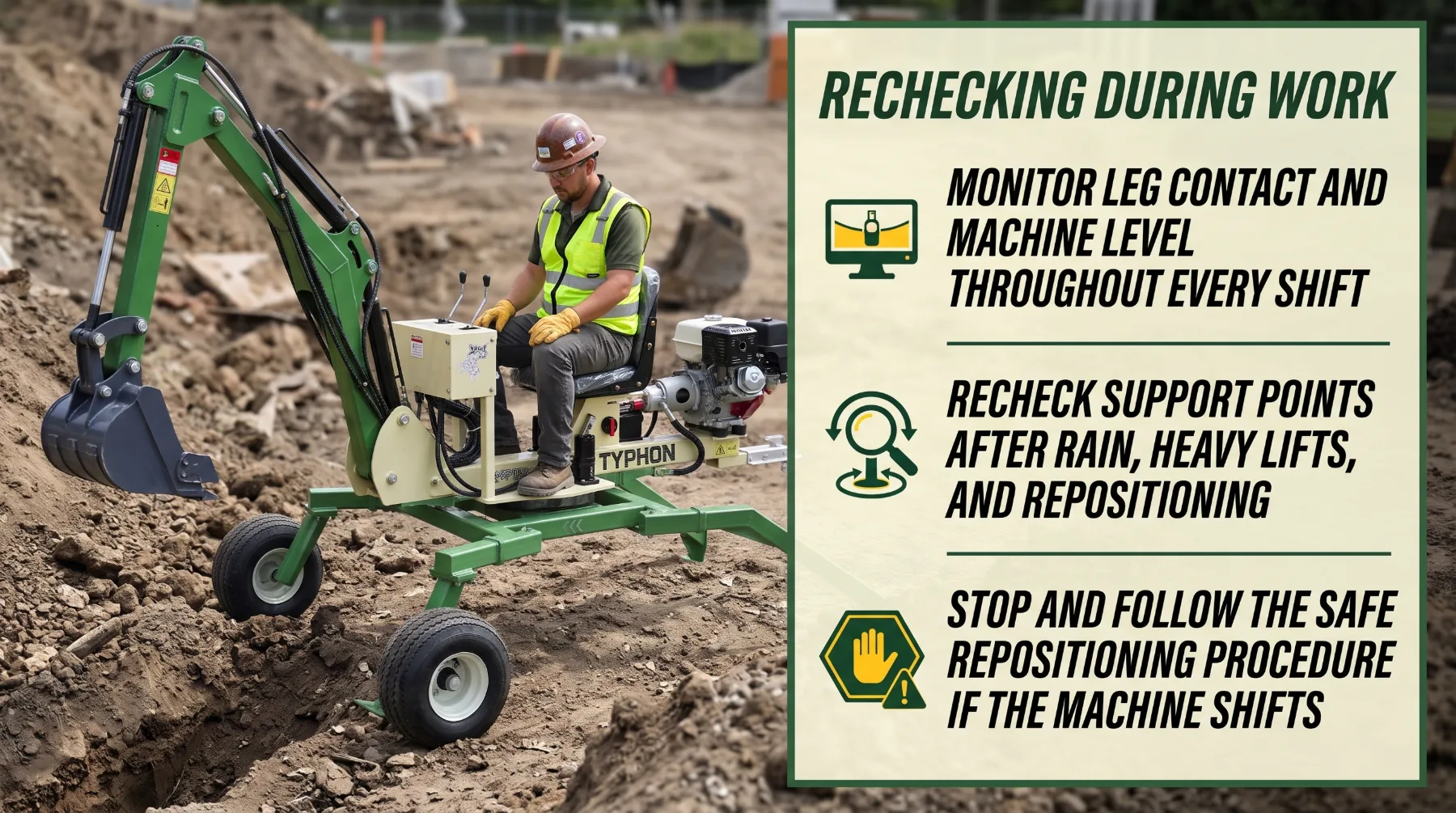
If the machine shifts or a support point becomes unstable, stop work and follow the manufacturer's safe repositioning procedure. That procedure typically involves bringing the boom and bucket in close, lowering the attachment to the ground in a controlled manner, and adjusting or moving the machine using the approved sequence. Never attempt to correct a sinking leg by suddenly extending it under load, by swinging the boom to counterbalance, or by continuing to dig in the hope of finishing the section.
Repositioning calls for the same care as the original setup. Assess the new support points, place and load the legs gradually, level the machine, and confirm it is within its permitted range before digging resumes.
Daily machine checks support stability as well. Before every shift, inspect the support legs, pads, leg cylinders, and pivot points for cracks, bends, weld damage, hydraulic leaks, and loose fasteners. Use a piece of cardboard rather than your hand to check for leaks, since pressurized fluid can cause serious injury. Confirm that leg adjustment and leveling functions move smoothly and hold position without drifting. Report any defect that affects stability, and keep the machine out of service until it has been corrected.
Record any settlement, ground changes, or repositioning events during the job. These notes help the crew understand how the site behaves and support safer planning for the remaining work.
Key takeaway: Monitor support contact, machine level, and ground conditions throughout the job, recheck after rain and breaks in work, and stop and follow the manufacturer's safe repositioning procedure whenever the machine shifts or a support point becomes unstable.
Conclusion
Leg positioning is central to spider excavator stability on uneven ground. A thorough ground assessment identifies loose soil, soft spots, voids, waterlogged areas, and unsupported edges before the machine arrives, and it treats every firm-looking surface with healthy caution. Support points chosen on firm, undisturbed ground or sound rock, supplemented only by manufacturer-approved pads, give each leg a reliable base. Setting the legs according to the manufacturer's procedure, and staying within the permitted leveling and support range, keeps the machine stable without overextending any leg. Controlled boom movements, close loads, and careful attention to downhill reach keep shifting forces within the machine's limits. A planned excavation sequence protects the ground beneath every support point, while continuous monitoring catches settlement, softening, and movement before they become emergencies.
These practices work together. No single step makes a setup safe on its own, and no amount of skill at the controls can make up for a poorly supported machine. When you assess the ground carefully, place every leg with purpose, operate within the machine's approved limits, and keep watching conditions as the work progresses, your spider excavator delivers precise, productive results on challenging terrain while protecting the operator, the crew, and the site.
FAQs
Can spider excavators work on any uneven surface?
No. The terrain must remain within the machine's permitted operating and support limits. Spider excavators can set up on ground that challenges conventional machines, but only when every leg rests on a support point that can carry the machine's loads and the machine can be leveled within its approved range. Steep slopes beyond the permitted angle, saturated ground, loose fill, hidden voids, and unsupported edges can make a site unsuitable. In those cases, prepare a working platform, select a different setup location, or choose another method.
Why are support pads sometimes needed?
Approved pads can distribute loads over a larger area when specified, but they do not make unstable ground safe by themselves. By increasing the contact area beneath a leg, pads reduce ground pressure and the tendency to sink on softer surfaces. Use only pads approved by the manufacturer for the specific machine, and never rely on improvised blocking or stacked materials. A pad placed over a void, on loose fill, or near an unsupported edge can still fail.
Can the excavator dig while a support leg is sinking?
No. Stop operation and address the instability using the approved procedure. A sinking leg means the support point can no longer carry the machine's loads, and continued digging can lead to a sudden tilt or tip. Bring the boom and bucket in close, lower the attachment to the ground in a controlled manner, and follow the manufacturer's procedure for repositioning onto stable ground before work resumes.
Should support legs be repositioned during excavation?
Only after following the manufacturer's safe procedure for stopping work, securing the machine, and repositioning. Repositioning is often necessary as excavation progresses toward the legs or as ground conditions change, and it should be planned into the excavation sequence. Stop digging, bring the attachment in and lower it, then move or adjust the legs using the approved sequence. Assess each new support point, load the legs gradually, and confirm the machine is within its permitted leveling and support range before digging continues.
