
Compaction Methods for Airport Runways
- Admin
- Uncategorized
- 11 Min Read
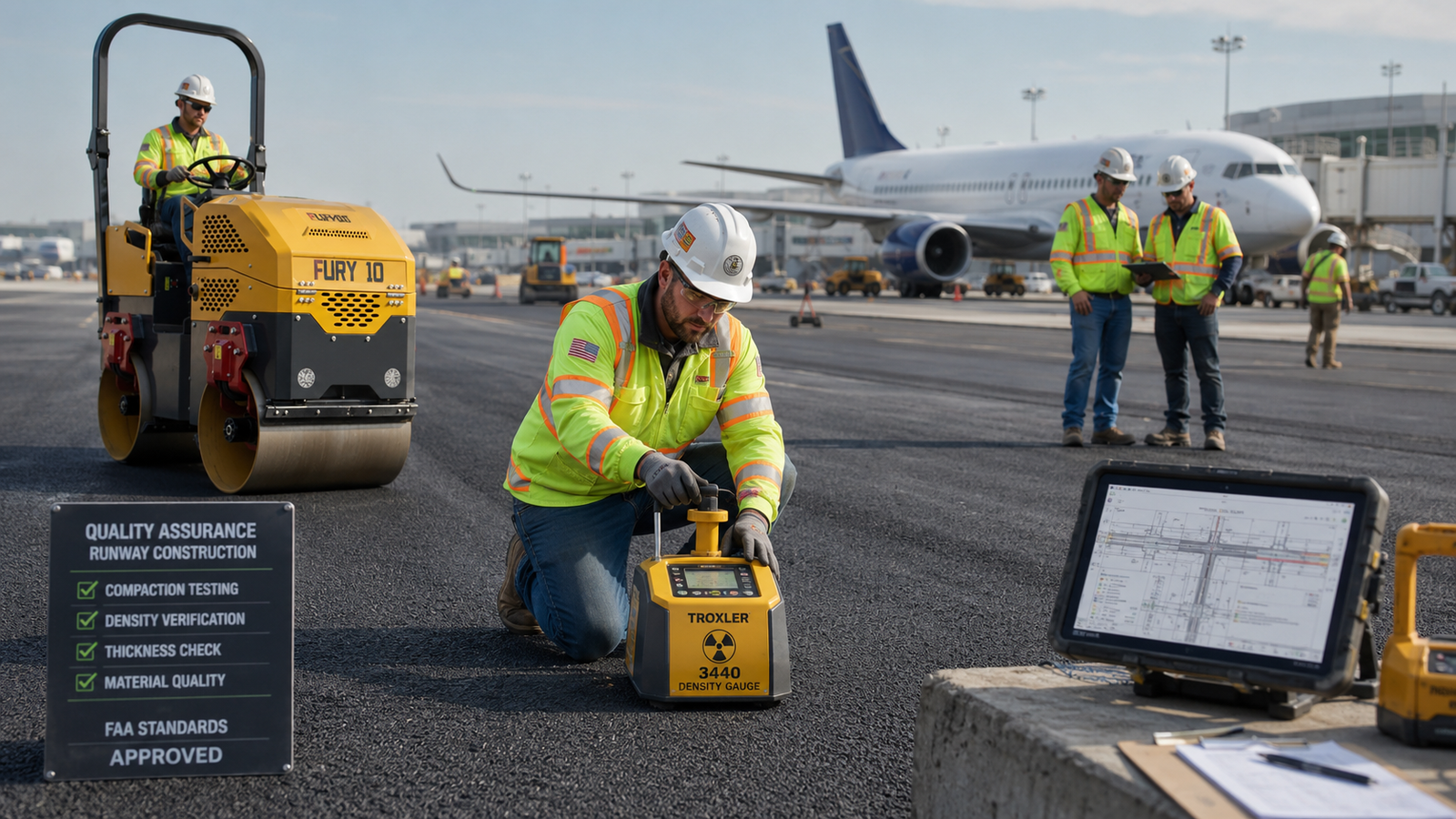
Airport runways carry some of the most demanding loads any pavement on earth will ever face. A fully loaded wide-body aircraft can weigh hundreds of tons, and it concentrates that weight onto a small set of tires that strike the surface repeatedly at high speed, day after day, in every kind of weather. The surface that absorbs those forces has to remain smooth, stable, and crack-free for decades, with little tolerance for the rutting and settlement that plague ordinary roads. What makes that endurance possible is not the visible pavement alone. It is the compaction beneath it, layer by layer, that determines whether a runway performs reliably or fails prematurely.
This guide is written for civil engineers, construction contractors, airport project managers, pavement specialists, and heavy equipment operators who carry responsibility for getting that work right. We will examine how proper compaction begins with the subgrade and builds upward through each engineered layer, how vibratory rollers, pneumatic tire rollers, and plate compactors each earn their place on the job, and how proctor and density testing confirm that the work meets FAA standards. Along the way, we will connect every technique to the real outcome that matters: a runway that resists rutting, cracking, and structural failure under relentless aircraft loading for the full span of its service life.
Subgrade Preparation: The Foundation Beneath Everything
Every runway, no matter how sophisticated its surface, ultimately rests on the natural soil beneath it. The subgrade is the platform that carries all the load transmitted down through the pavement structure, and if it is weak, uneven, or poorly compacted, no amount of quality work above it can compensate. This is the first and most consequential stage of any runway project, because mistakes made here echo upward through every layer and surface that follows.
The challenge with subgrade is that natural soil rarely arrives in the condition a runway demands. It may be loose, contain organic material, hold inconsistent moisture, or vary in composition across the length of the project. Left untreated, these conditions invite differential settlement, where one section of the runway sinks more than another, producing the uneven surfaces and stress concentrations that lead to cracking and pavement failure. The goal of subgrade compaction is to create a uniform, stable, and properly densified base that behaves consistently under load across the entire footprint.
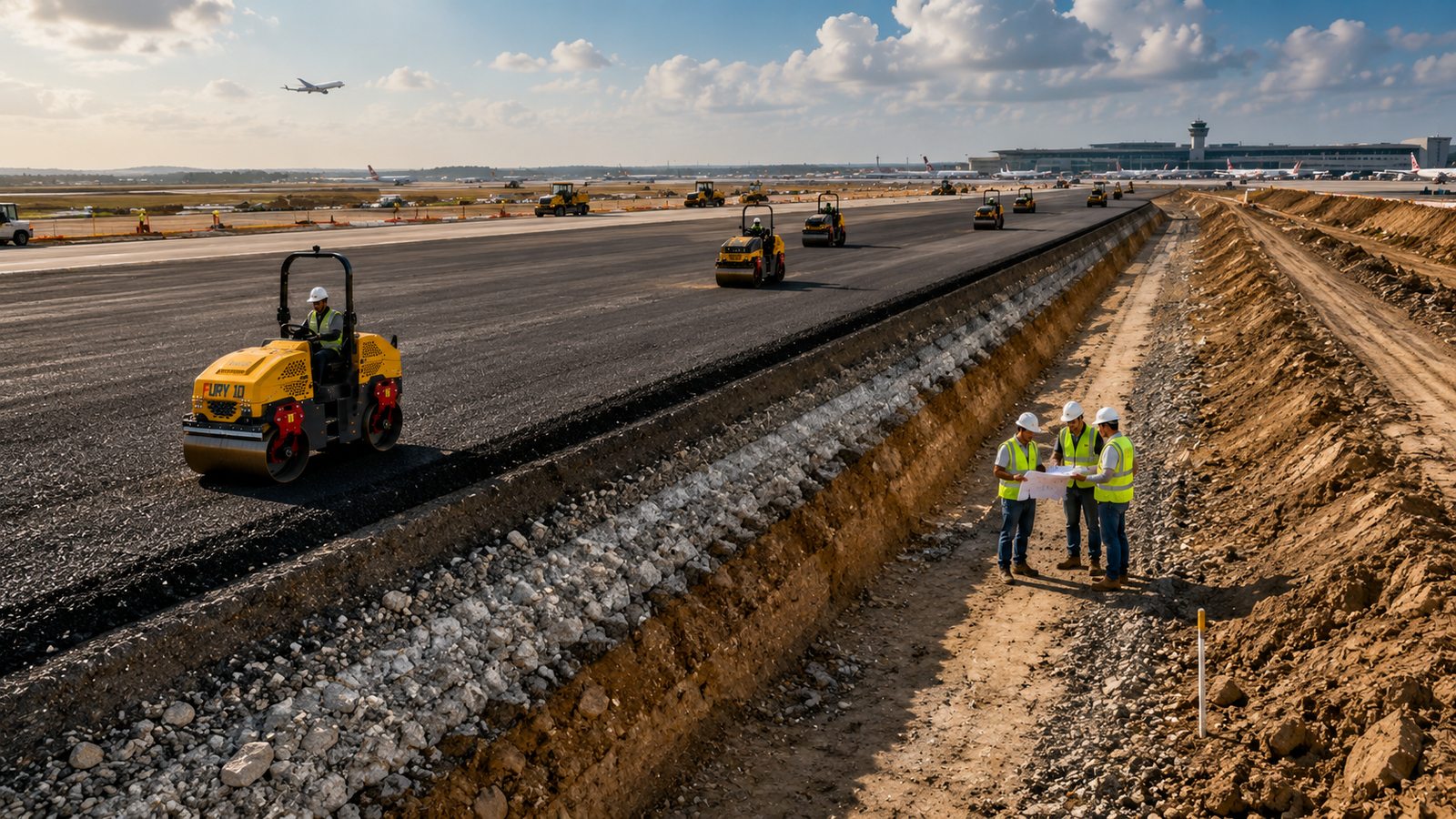
Achieving that uniformity requires removing unsuitable material, controlling moisture to the optimum level, and compacting the soil in controlled lifts until it reaches the specified density. Engineers verify this against proctor test values, which establish the target density and moisture for each soil type, a relationship we will return to shortly. Heavy vibratory rollers and sheepsfoot rollers typically handle this work, kneading and densifying the soil until it can bear the loads above it without shifting. Get the subgrade right, and you have built a dependable foundation. The next step is to strengthen that foundation further with engineered granular layers.
Building the Subbase and Base: Strength in Layers
With a sound subgrade in place, attention turns to the subbase and base courses, the engineered granular layers that distribute aircraft loads and protect the soil beneath. These layers act as the structural bridge between the raw subgrade and the finished pavement, spreading concentrated wheel loads across a wider area so that the pressure reaching the soil stays within safe limits. Their quality directly governs how the entire pavement structure performs under traffic.
The difficulty here lies in achieving consistent density throughout granular material that can behave unpredictably if it is placed too thick or at the wrong moisture content. A base course that is under-compacted leaves voids and weak zones, and those zones become the starting points for settlement and surface distress once aircraft begin pounding the runway. Because granular layers depend on the interlock of their aggregate particles for strength, they must be compacted thoroughly enough to lock those particles tightly together while maintaining the gradation the design specifies.
This is where lift thickness becomes critical. Placing material in lifts that are too deep prevents compaction energy from reaching the bottom of the layer, leaving it loose beneath a deceptively firm surface. Contractors instead build these courses in controlled lifts sized to the capability of their equipment, compacting each one fully before placing the next. Vibratory rollers handle the bulk of this work, with pneumatic tire rollers often following to seal the surface and tighten the upper portion of the layer. With each layer verified for density, the structure grows steadily stronger, setting the stage for the surface course that aircraft will actually touch.
Asphalt Compaction: Sealing the Flexible Surface
For runways built with flexible pavement, the asphalt surface course is where compaction becomes an exacting, time-sensitive craft. Hot-mix asphalt arrives on site at high temperature, and it must be placed and compacted within a narrow window before it cools beyond the point where density can still be achieved. This is the layer that meets the tires, sheds water, and endures the direct impact of every landing, so its integrity defines how the runway performs at the surface.
The core problem in asphalt compaction is air voids. Asphalt that is left with too high a void content allows water and air to penetrate the mix, accelerating oxidation, stripping, and the formation of cracks and potholes. Too little void content, on the other hand, can lead to instability and rutting under heavy loads. The compaction process must drive the mix to a density that falls within a tightly specified range, eliminating excess voids while preserving the stability the design intends. On a high-stress airport surface, this margin for error is far smaller than it would be on an ordinary road.
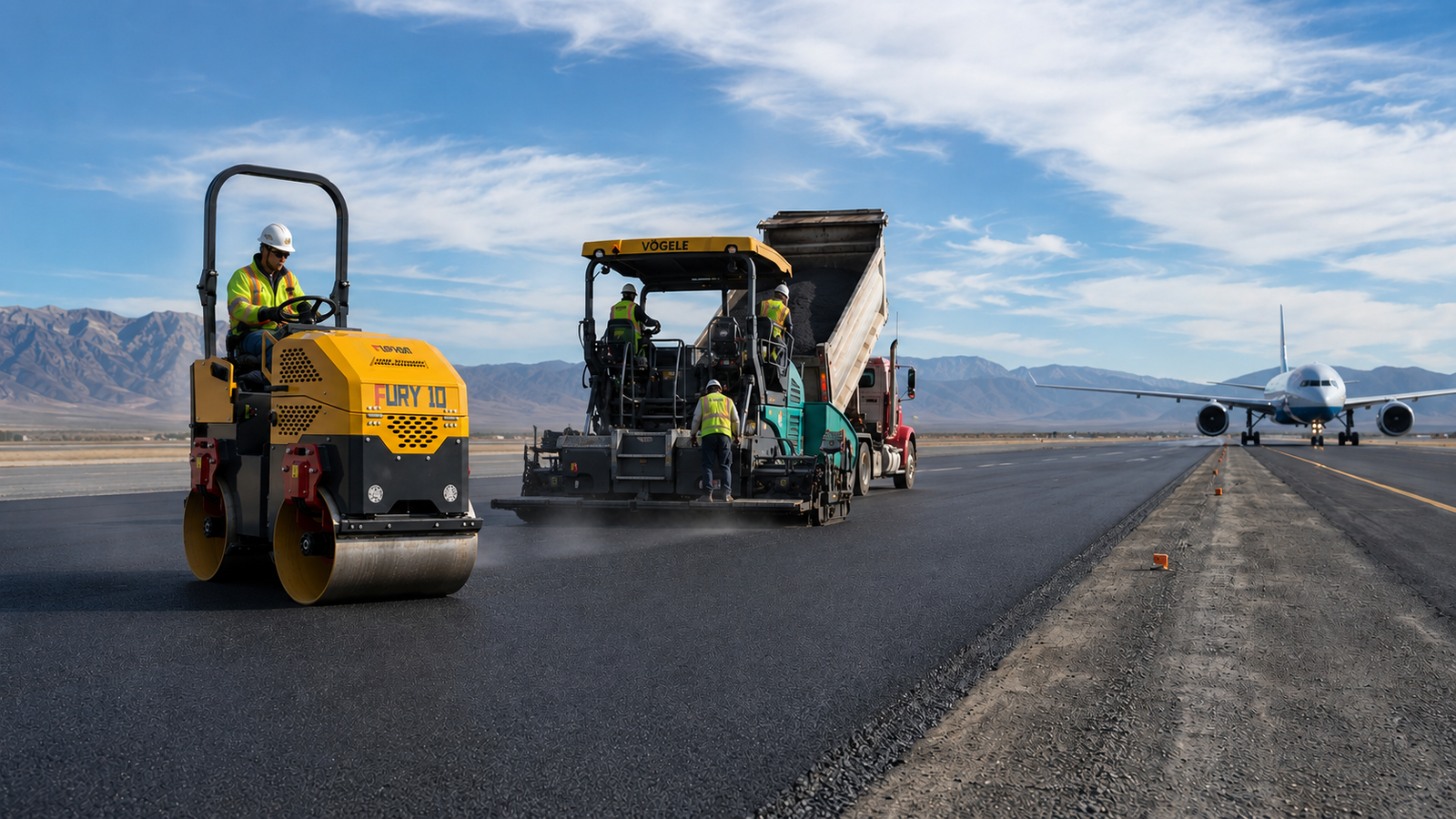
Achieving that balance relies on a coordinated rolling pattern that begins almost immediately behind the paver. Heavy vibratory rollers perform the breakdown rolling that establishes most of the density while the mat is still hot, pneumatic tire rollers follow with an intermediate pass that kneads the mix and tightens the surface, and static steel rollers complete the finish rolling that removes roller marks and produces the smooth final texture. Temperature control, roller speed, and the number of passes all have to be managed precisely, because the mat cools continuously and every pass counts. When this sequence is executed well, the asphalt seals into a dense, durable surface. Rigid concrete runways, however, demand a very different approach.
Concrete Compaction: Consolidating Rigid Pavement
Many of the world’s busiest runways are built from rigid concrete pavement, prized for its strength and longevity under the heaviest aircraft. Concrete does not compact in the rolling sense that soil and asphalt do; instead, it must be consolidated, a process that removes entrapped air and ensures the mix fully surrounds the reinforcement and fills the forms completely. The principle is the same, though: eliminate voids to produce a dense, sound material that performs reliably under load.
The risk with concrete is that poorly consolidated mix leaves honeycombing, voids, and weak zones that compromise strength and durability. Entrapped air pockets reduce the concrete’s load-bearing capacity and create paths for water intrusion, which in cold climates leads to freeze-thaw damage and spalling. Because a runway slab must resist enormous bending and impact forces without cracking, any consolidation flaw becomes a serious liability over the pavement’s long service life.
Consolidation is typically achieved with internal vibrators and the vibratory screeds built into modern slipform paving equipment, which work the concrete just enough to release trapped air without causing segregation of the aggregate. Striking that balance demands skilled operation, since over-vibration drives heavy aggregate downward and brings excess paste to the surface, weakening the slab. Proper mix design, controlled placement, and disciplined finishing all work together to produce a uniform, fully consolidated slab. Whether the runway is flexible or rigid, none of this work means anything until it is verified, which brings us to the role of testing.
Proctor and Density Testing: Proving the Work
Compaction is only as good as the proof behind it, and on an airport project that proof is non-negotiable. Visual inspection cannot confirm whether a layer has reached its required density, and the consequences of guessing wrong are far too severe. A rigorous program of laboratory and field testing converts compaction from an assumption into a verified, documented fact that satisfies both engineering requirements and FAA standards.
The process begins in the laboratory with the proctor test, which establishes the relationship between a soil’s moisture content and the maximum dry density it can achieve. This test produces the benchmark, the optimum moisture content and maximum dry density, against which all field compaction is measured. Without it, crews would have no defensible target to work toward, and moisture control on the job would amount to guesswork. The proctor result is the standard that defines success for every lift placed on the project.
In the field, technicians confirm that the placed material actually meets that standard using methods such as the nuclear density gauge, sand cone test, or non-nuclear alternatives, each measuring in-place density and moisture so they can be compared against the proctor benchmark. Results are typically expressed as a percentage of maximum dry density, and runway specifications demand high compaction percentages that leave little tolerance for shortfalls. For asphalt and concrete, density and core testing serve the same verifying role. This documentation protects everyone involved: it confirms the runway will perform as designed, satisfies regulatory oversight, and provides a defensible record that the work was done correctly. Reliable results, however, depend heavily on choosing the right equipment for each task.
Equipment Selection and Moisture Control: Matching Tools to Conditions
The finest specifications mean little without the right machines applying compaction energy in the right way, and equipment selection is where engineering intent meets jobsite reality. Different materials and layers respond to different compaction forces, and matching the equipment to the conditions is what separates efficient, uniform results from inconsistent work that fails testing and invites rework. This decision shapes productivity, quality, and ultimately the long-term integrity of the runway.
The difficulty is that no single machine handles every situation well. A vibratory roller that excels at densifying granular base material may be poorly suited to the finish rolling of an asphalt mat, and a plate compactor essential for tight, confined areas cannot match the output of a large roller across open expanses. Vibratory rollers deliver dynamic force ideal for soils and granular layers, pneumatic tire rollers provide a kneading action that seals surfaces and reaches density without leaving marks, and plate compactors handle the edges, joints, and confined zones around structures that larger equipment cannot reach. Choosing the wrong tool wastes time and leaves weak spots precisely where the design can least afford them.
Running parallel to equipment choice is the discipline of moisture control, which governs how effectively any of these machines can perform. Soil and granular material compact best at their optimum moisture content, the value established by the proctor test, because moisture lubricates the particles enough to let them rearrange into a dense configuration. Material that is too dry resists compaction and rebounds, while material that is too wet becomes unstable and cannot hold density. Crews manage this by watering dry material or aerating wet material until it reaches the target range before compaction begins. When the right equipment works material at the correct moisture, compaction proceeds efficiently and the results meet specification consistently, protecting the runway against the distress that poor compaction would otherwise guarantee.
Conclusion
Compaction is the quiet discipline that determines whether an airport runway endures or deteriorates, and it succeeds only when every stage is executed with care. It begins with a uniform, properly densified subgrade, builds upward through engineered subbase and base courses placed in controlled lifts, and culminates in either a tightly compacted asphalt surface or a fully consolidated concrete slab. Throughout, proctor and density testing verify that each layer meets its target, moisture control keeps the material workable, and carefully selected equipment applies the right force in the right place. Together these practices produce a pavement structure capable of carrying immense aircraft loads while resisting the rutting, cracking, and failure that compromise lesser surfaces.
For civil engineers, construction contractors, airport project managers, pavement specialists, and equipment operators, the lesson is that runway performance is built from the ground up, one verified layer at a time. The most direct way to protect a runway’s long-term integrity is to honor the fundamentals: prepare the subgrade thoroughly, respect lift thickness, control moisture to the optimum, match equipment to each task, and test rigorously against FAA standards before moving on. Approach the work with that discipline, and the runway will repay the effort with decades of safe, dependable service under some of the most demanding loads in all of construction. Done right, compaction becomes the foundation of a surface the traveling public will never think about, which is exactly the point.
