
Stability, Lift Capacity, and Load Handling for Tri-Loader Equipment
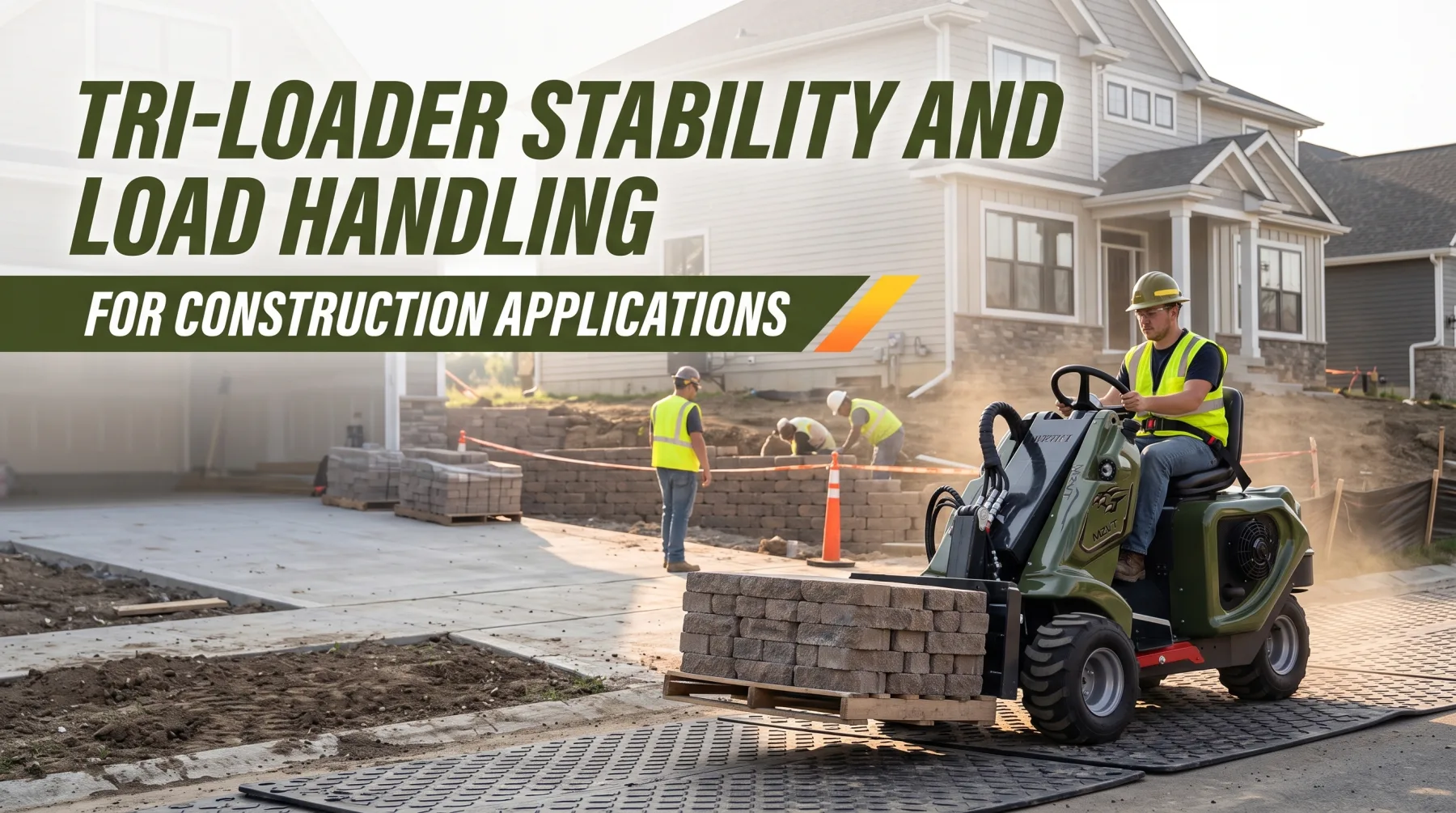
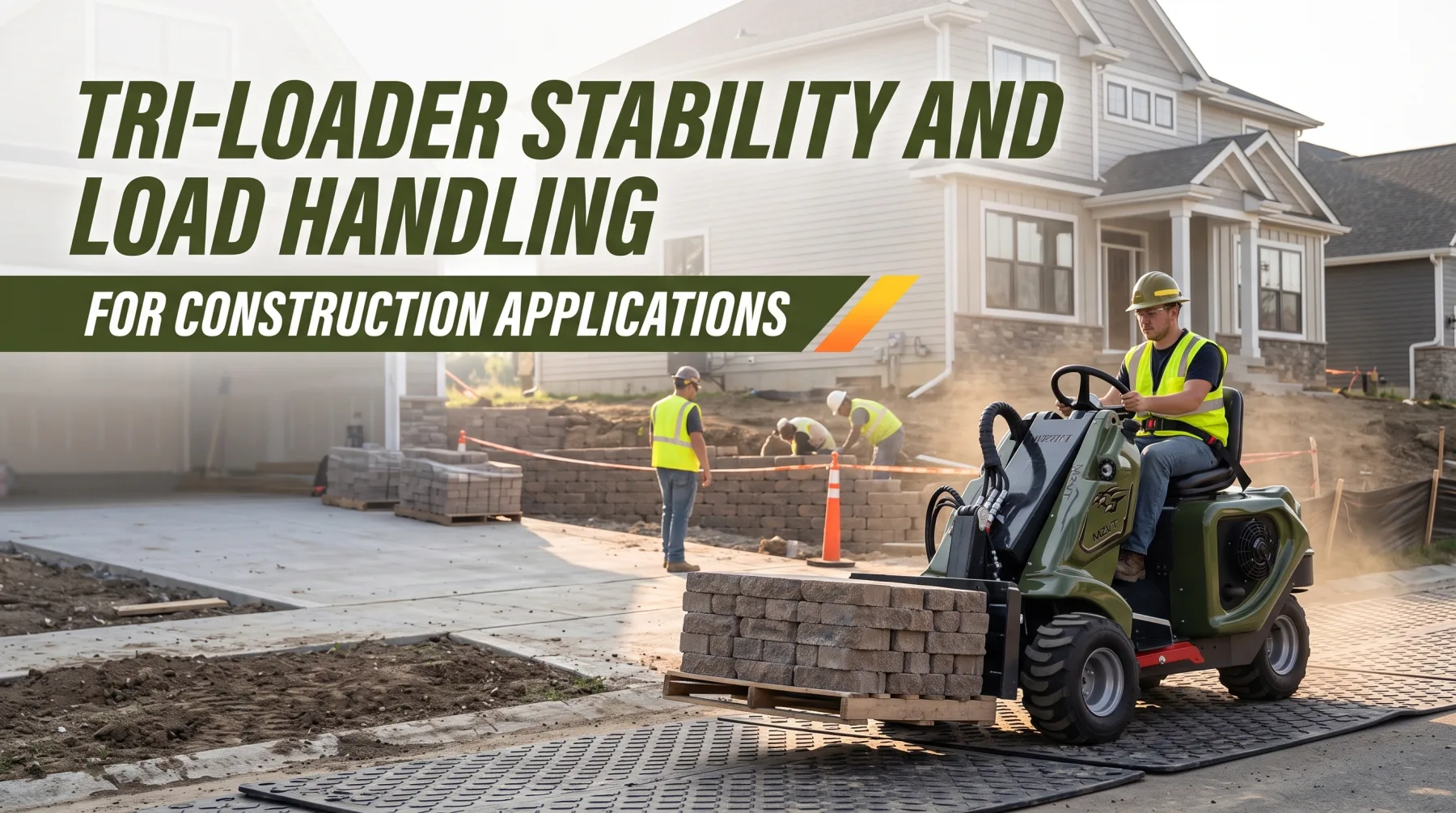
Tri-loaders can move heavy materials efficiently, but stability changes as load height, weight, and ground conditions change. Uneven surfaces, soft backfill, obstacles, and raised loads can shift the machine’s balance during travel, especially when carrying pallets or other concentrated loads. Keeping the machine stable requires careful route planning, proper load positioning, and controlled operation.
Center of gravity and rated capacity establish important limits for lifting and carrying materials. Loads should remain within the machine’s rated capacity, centered properly on the attachment, and carried as low as practical during travel to help maintain stability. Ground conditions, slopes, attachment security, and hydraulic movements also affect how the machine responds when accelerating, turning, crossing uneven surfaces, or approaching obstacles.
Operators should inspect the travel route before moving loads and remove obstacles or address soft areas where necessary. Secure attachment connections, smooth hydraulic inputs, appropriate travel speed, and proper load placement help reduce sudden shifts and maintain control throughout each cycle. Combining capacity awareness with careful positioning and route management supports safer, more predictable material handling on construction and landscaping sites.
Machine Stability and Center of Gravity
Every tri-loader stays upright because its center of gravity remains inside its base of support. On a compact three-wheel machine, the wheels form a triangular base. As long as the combined center of gravity of the machine and its load stays within that triangle, the machine remains stable. When the center of gravity moves toward or beyond the edge of the triangle, the machine can tip.
The machine’s own weight, counterweighting, and wheel placement are engineered to keep that balance within the rated operating capacity. The load changes the equation. A load in the bucket or on the forks adds weight in front of the machine, which pulls the combined center of gravity forward. Raising that load also moves the center of gravity upward. The higher it sits, the smaller the tilt needed to push it outside the base of support. That’s why a load that feels steady near the ground can feel very different at full lift height.
Movement adds another layer. Turning, braking, and accelerating create forces that shift the center of gravity sideways, forward, or back. A sharp turn with a raised load can move weight toward the outside edge of the triangle quickly. A hard stop pushes weight forward toward the front wheels. On a three-wheel layout, side-to-side balance deserves particular attention, since the base narrows toward the single wheel.
Controlled positioning keeps these forces manageable. Approach every lift on firm, level ground with the machine square to the load. Lift and lower with the machine stopped whenever possible, carry loads low during travel, and make wide, gradual turns. Watch for warning signs such as a light feeling at the rear, a wheel losing contact, or a machine that feels unsettled during a turn. Any of these means the load should come down before you continue.
Key takeaway: Stability depends on keeping the combined center of gravity inside the machine’s base of support, so lift on level ground, keep loads low, and move smoothly to prevent sudden shifts in balance.
Load Position During Travel
How you carry a load matters as much as how much you carry. Load height during travel affects both machine balance and operator visibility. A load carried at the right height keeps the center of gravity low and gives the operator a clear view of the path ahead. A load carried too high does the opposite.
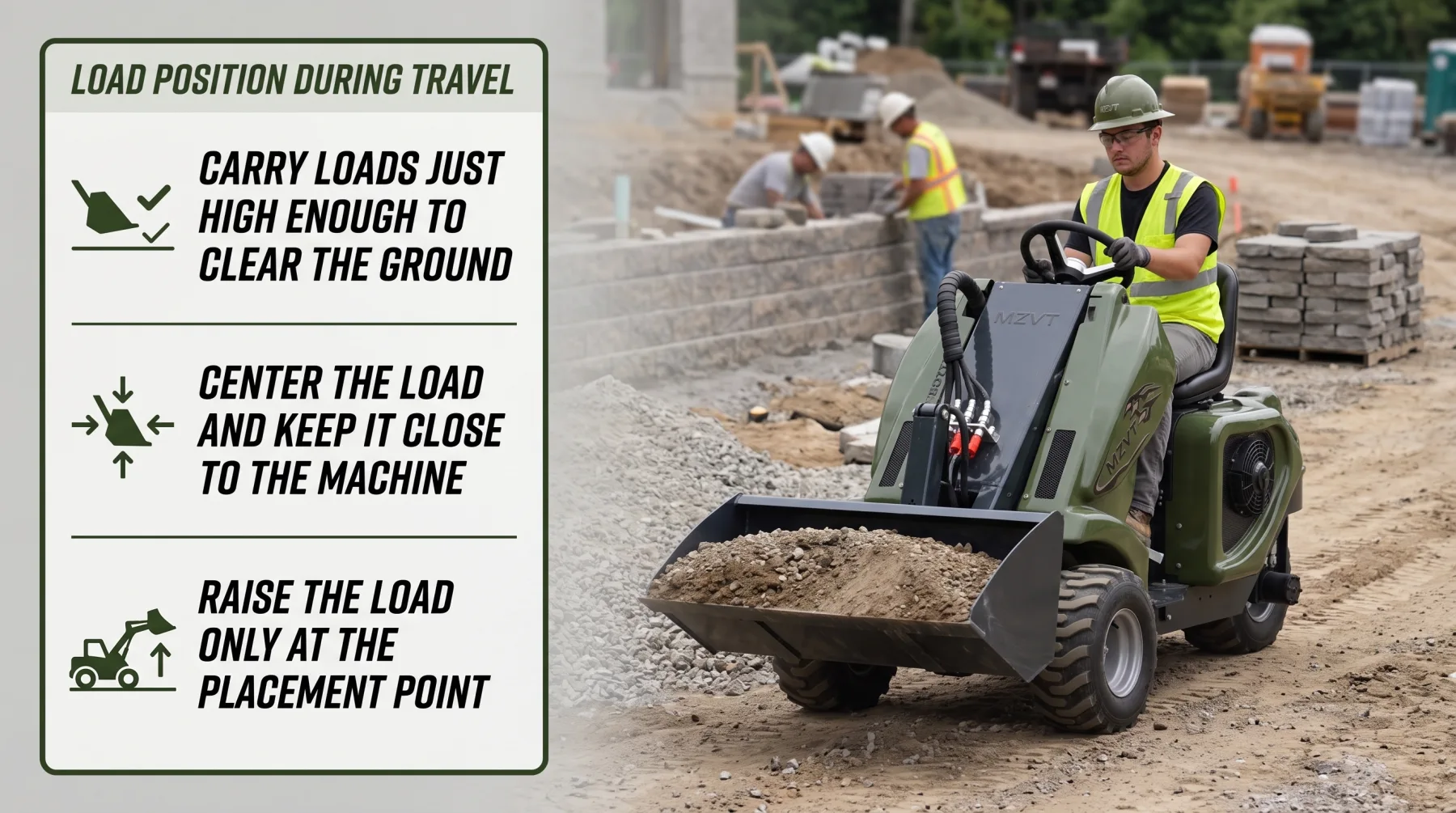
Carry the load just high enough to clear the ground and any obstacles along the route. With a bucket, keep it low and slightly curled back so material stays in place. With pallet forks, keep the forks low with a slight backward tilt where the machine allows, so the load rests securely against the backrest. This position keeps the combined center of gravity close to the ground and well inside the machine’s base of support, even when a wheel drops into a rut or crosses a bump.
A raised load changes how the machine responds to every surface. On uneven ground, small tilts become much larger shifts in balance when the load sits high. A raised load also blocks part of the operator’s forward view, which increases the risk of striking workers, materials, or structures. If an obstacle sits in the travel path, clear the obstacle or reroute the trip rather than lifting the load to pass over it.
Keep the load centered and close to the machine. A bucket filled evenly and a pallet centered on the forks place weight where the machine is designed to carry it. Raise the load only when you reach the placement point and the machine is stopped and positioned. Once the load is placed, lower the attachment before traveling again. Slow down before rough sections, approach slopes straight on, and avoid turns with a raised attachment.
Key takeaway: Carrying loads low, centered, and close to the machine maintains balance and visibility, while excessively raised loads make movement across uneven surfaces less predictable.
Load Capacity and Material Weight
Every tri-loader has a rated operating capacity, which is the maximum load the manufacturer specifies for safe operation. You’ll find it on the machine’s capacity decal and in the operator’s manual. That figure represents a safety margin below the point where the machine would begin to tip, and it includes the weight of the attachment itself. Treating rated capacity as a hard limit protects the operator, the crew, and the machine.
The challenge on most jobsites is that material weight isn’t always obvious. Density varies widely between materials. A bucket of dry mulch weighs far less than the same bucket of wet topsoil, sand, or crushed stone. A pallet of wall block or pavers can weigh much more than its size suggests. Moisture adds weight quickly, so material that was within capacity on a dry morning may exceed it after a rainstorm. Load by weight first, using the material’s approximate density, and treat bucket volume as a secondary guide.
Load position also affects capacity. Many manufacturers publish capacity charts showing how the safe load changes with lift height and how far forward the load sits. Pallet forks place the load farther forward than a bucket, so the same weight has more leverage on the machine. A pallet pushed toward the fork tips rather than seated against the backrest reduces the margin even further. Review the full capacity information for your machine, not just the headline number.
Exceeding rated capacity reduces stability and places excessive stress on loader arms, pivot pins, cylinders, tires, and the frame. It also makes the machine slower to lift and harder to steer. If the rear feels light, lifting slows noticeably, or the machine bounces heavily during travel, reduce the load before the next trip.
Key takeaway: Material density and load size determine the actual weight carried, so estimate every load by weight, include the attachment, and stay within the machine’s rated operating capacity.
Ground Conditions and Stability
Ground conditions directly affect a tri-loader’s stability, traction, and load control. Soft soil, slopes, ruts, debris, and changing weather can shift the machine or reduce its ability to travel safely. Checking and preparing the travel route before work helps maintain better control and reduce unnecessary risks.
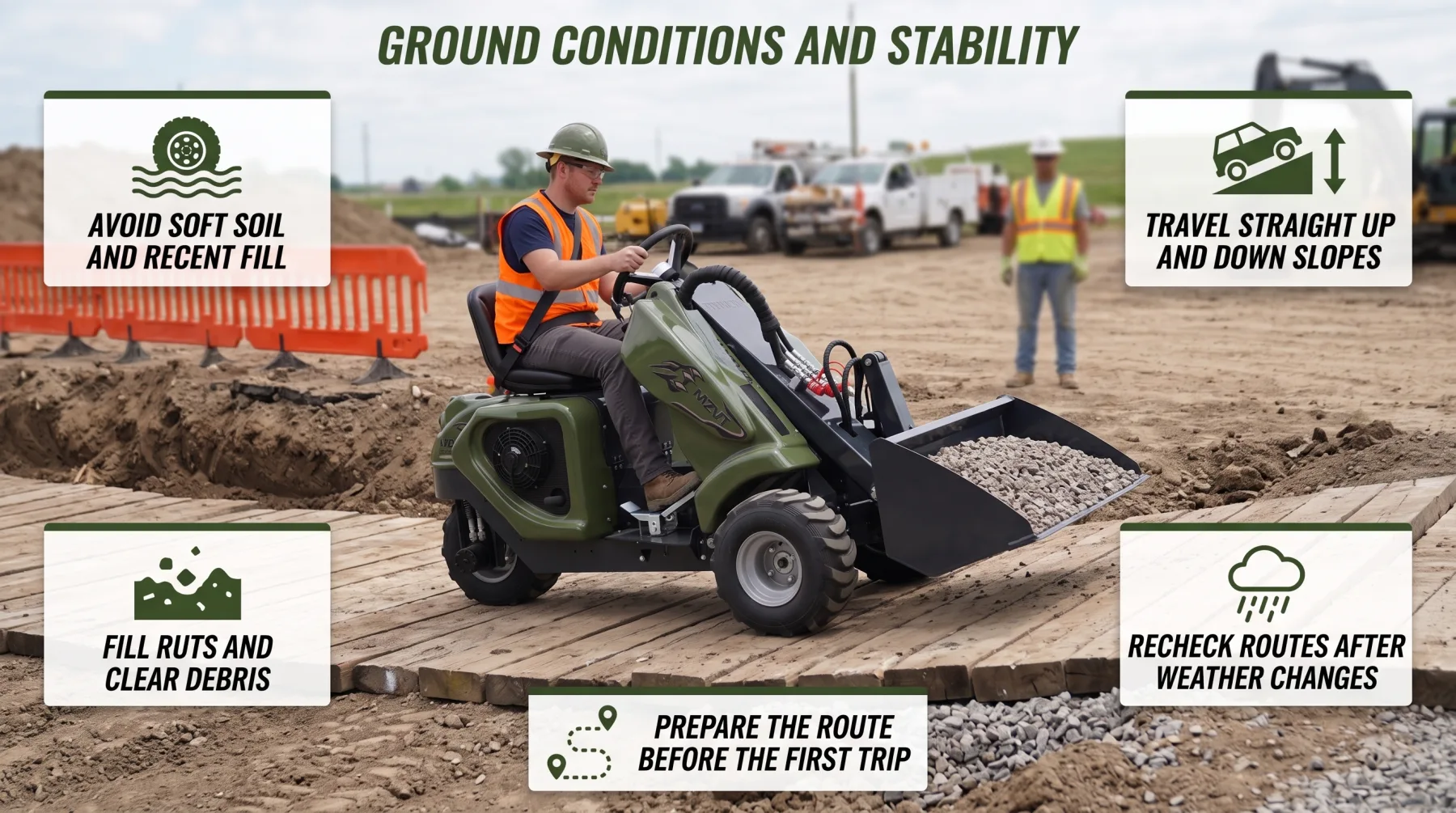
Soft Soil & Fill: Loose fill, saturated soil, and recently backfilled areas can compress under load and cause the machine to tilt.
Slopes & Inclines: Follow manufacturer slope limits, travel straight on grades where required, and keep loads low to maintain stability.
Ruts & Obstacles: Holes, ruts, rocks, and debris can cause sudden jolts or shifts in the machine and its load.
Weather Conditions: Rain, mud, frost, and standing water can change traction and ground strength during the workday.
Route Preparation: Inspect, grade, and stabilize regular travel paths while keeping the machine away from unstable edges and soft areas.
Key takeaway: Soft, uneven, sloped, or unstable ground can change machine stability during lifting and travel, so assess and prepare the surface first and never operate beyond the machine’s safe working limits.
Attachment and Load Security
A stable machine still depends on a secure attachment and a secure load. Buckets, pallet forks, grapples, and other tools each handle different materials, and the right choice supports both stability and efficient handling. An attachment that isn’t suited to the material, or one that isn’t fully connected, can let a load shift or fall at the worst possible moment.
Start by matching the attachment to the material. A bucket suits loose soil, gravel, sand, and mulch. Pallet forks handle block, pavers, sod, and bagged materials that would be damaged or unstable in a bucket. Grapples secure brush, logs, and irregular debris that could roll out of an open bucket. Carrying palletized material in a bucket or loose debris on forks invites load shifts that can unsettle the machine. Every attachment also has its own weight and load position, which affect how much capacity remains for the material.
Secure connection comes next. Follow a consistent procedure for every attachment change. Park on firm, level ground, clean mud and gravel from the mounting plate and locking points, seat the attachment, and engage the locking mechanism according to the manufacturer’s instructions. Then visually confirm that each lock is fully engaged before lifting any load. Packed debris in a lock slot is a common cause of incomplete engagement. For hydraulic attachments, relieve system pressure before connecting hoses and route them away from pinch points.
The load itself must be secure as well. Center pallets on the forks and seat them against the backrest. Check that pallets are intact and that stacked material is banded or stable. Fill buckets evenly without heaping material high enough to spill. Close grapples firmly around irregular loads. Inspect attachments regularly for bent tines, cracked welds, and worn locking components, and repair damage before the attachment returns to work.
Key takeaway: A suitable attachment, a fully engaged lock, and a properly secured load work together to support stability and handling efficiency, so confirm all three before every lift.
Hydraulic Control During Lifting
Hydraulics raise, lower, and tilt the attachment, and how the operator uses them has a direct effect on load stability. Smooth hydraulic control lets the operator position a load precisely without shifting the machine’s balance. Abrupt movements do the opposite, sending sudden forces through the load, the loader arms, and the machine.
Proportional hydraulic controls allow gradual movement. Use small, steady inputs to start each lift, increase speed only once the load is moving smoothly, and ease off before reaching the target height. Feather every movement to a smooth stop before changing direction. A load that jerks upward or stops suddenly can shift on the forks or in the bucket, and that shift moves the center of gravity at the moment the machine is most sensitive to it.
Lifting and travel should be separate whenever possible. Raise and lower loads with the machine stopped and square to the placement point rather than lifting while driving or turning. When placing material, lower the load slowly and tilt the bucket gradually so material releases in a controlled flow. When setting pallets, lower them gently onto firm, level ground and withdraw the forks straight back.
Hydraulic behavior also signals the machine’s condition. Loader arms that drift down with the controls in neutral, jerky or delayed movement, or unusual pump noise can point to low fluid, a leak, or worn components. If you notice any of these signs, lower the load to the ground and have the system inspected before continuing. Inspect hoses, fittings, and cylinders during every walkaround, and never check for hydraulic leaks by running your hand along a hose. Pressurized fluid can penetrate skin and cause serious injury, so use a piece of cardboard instead.
Key takeaway: Gradual, controlled hydraulic movement reduces sudden load shifts during lifting, travel, and placement, so use smooth inputs, lift with the machine stopped, and stop work at the first sign of drift or uneven response.
Conclusion
Tri-loader stability and load handling come down to how well the operator manages the relationship between the machine, the load, and the ground beneath it. Keeping the combined center of gravity inside the machine’s base of support is the foundation, and that depends on staying within rated operating capacity, estimating loads by weight rather than volume, and accounting for the attachment’s own weight and load position. Carrying loads low, centered, and close to the machine protects both balance and visibility, while careful assessment and preparation of soft, sloped, or uneven ground prevents the sudden tilts that unsettle a loaded machine. A suitable attachment, a fully engaged lock, and a secure load keep material where it belongs, and smooth, gradual hydraulic control prevents the sudden shifts that can turn a routine lift into a close call. When each of these factors receives consistent attention, a tri-loader delivers reliable, controlled material handling across every construction application. Before your next shift, confirm the capacity decal against the weight of the day’s materials, walk the travel route for soft spots and obstacles, and visually check that every attachment lock is fully engaged before the first lift.
Frequently Asked Questions
What affects tri-loader stability?Load weight, machine position, center of gravity, ground conditions, attachment type, and load height all influence tri-loader stability. Keeping loads low and properly centered helps maintain a lower center of gravity during travel and lifting. Operators should also work on suitable ground and remain within the machine’s rated operating limits.
Why should loads remain within rated capacity?Exceeding the rated capacity can reduce machine stability and place excessive stress on structural, hydraulic, and lifting components. The rated capacity must account for the attachment and the material being handled, not just the material weight. Staying within the specified limit supports safer lifting, predictable handling, and longer component life.
Does ground condition affect load handling?Yes. Soft, uneven, wet, or sloped surfaces can change traction, balance, and machine stability during lifting and travel. Poor ground may cause the machine to shift or tilt unexpectedly under load. Preparing firm travel routes, avoiding unstable recent fill, and adjusting operation to site conditions help improve control.
Why is smooth hydraulic control important?Controlled hydraulic movement helps reduce sudden load shifts during lifting, travel, and material placement. Gradual joystick inputs allow the loader arms and attachment to move more predictably, reducing unnecessary movement and stress. Smooth operation is especially important when handling elevated loads or working near structures, workers, and other equipment.
